


Core Function of the Csf1r Gene: The "Master Switch" of Brain Immunity
The Csf1r (Colony-Stimulating Factor 1 Receptor) gene encodes a critical transmembrane tyrosine kinase receptor, primarily expressed on the surface of myeloid immune cells such as microglia. It acts as a precisely regulated "switch," controlling the survival, proliferation, differentiation, and function of microglia—the brain's resident immune cells.
In a healthy brain, the CSF1R signaling pathway ensures that microglia can effectively perform their physiological functions, such as pruning synapses during neurodevelopment, shaping neural networks, and clearing pathogens and cellular debris in response to injury or infection. Therefore, the normal function of Csf1r is fundamental to maintaining immune homeostasis and the health of the nervous system.
Csf1r Gene Mutations: A Common Thread from Rare Diseases to Complex Neurological Disorders
When the Csf1r gene is mutated, this "master switch" malfunctions, leading to microglial dysfunction and disrupting the brain's immune balance—an underlying driver of multiple neurodegenerative diseases.
A classic example is Adult-onset Leukoencephalopathy with Axonal Spheroids and Pigmented Glia (ALSP), a rare, fatal genetic disorder caused by Csf1r mutations. Patients experience rapid deterioration in motor and cognitive functions due to dysfunctional microglia.
More broadly, Csf1r dysfunction is closely associated with the pathology of multiple neurodegenerative diseases (e.g., Alzheimer's disease), psychiatric disorders (e.g., schizophrenia), and brain tumors. In these complex conditions, dysfunctional microglia may fail to effectively clear harmful substances (like amyloid-beta) and may even release pro-inflammatory factors, exacerbating neuroinflammation and neuronal damage.
Therapeutic Strategies Targeting Csf1r: From "System Reinstallation" to "Reboot and Repair"
Bone Marrow Transplantation—"Reinstalling" the Brain's Immune System
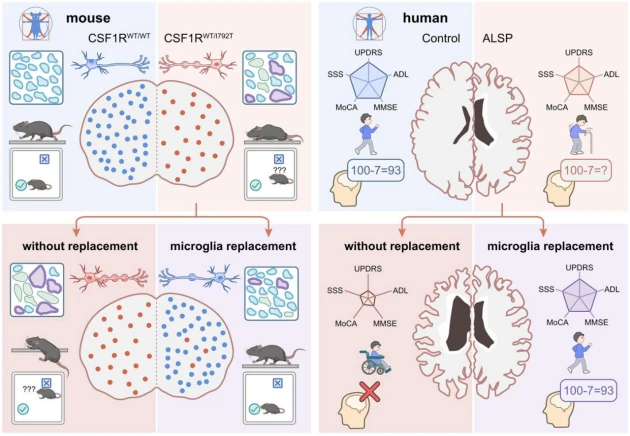
A recent cover story in Science showcased a groundbreaking advancement. Researchers successfully used bone marrow transplantation to replace dysfunctional microglia caused by Csf1r mutations in ALSP patients with healthy donor cells. The genetic defect reduces the "competitiveness" of endogenous microglia, enabling efficient microglial replacement with traditional bone marrow transplantation (tBMT), thereby "reinstalling" the brain's immune system.
Csf1r Inhibitors—"Rebooting" Microglial Function
In contrast to the "reinstallation" strategy, Csf1r inhibitors offer a way to "reboot" the dysfunctional cell population. By temporarily blocking the CSF1/CSF1R signaling pathway, it is possible to deplete the brain of dysfunctional microglia on a large scale. After drug withdrawal, new, functional microglia repopulate, thereby "resetting" the entire microglial environment and restoring beneficial physiological functions. This strategy shows great potential in neuroscience and oncology—for example, eliminating or "re-educating" tumor-associated macrophages (TAMs).
Csf1r Gene-Edited Mouse Models: A Powerful Tool to Accelerate Neuroscience Research
High-quality animal models are essential for in-depth study of Csf1r and for developing new therapeutic methods. Cyagen has utilized advanced gene-editing technologies to create a series of standardized gene-edited mouse models, providing powerful tools for scientists worldwide.
| Product Name | Product ID | Strain Full Name | Type |
|---|---|---|---|
| Csf1r-KO Mouse | S-KO-01659 | C57BL/6NCya-Csf1rem1/Cya | Csf1r Knockout |
| Csf1r-KO Mouse | S-KO-01660 | C57BL/6JCya-Csf1rem1/Cya | Csf1r Knockout |
| Csf1r-KO Mouse | S-KO-19881 | C57BL/6JCya-Csf1rem1/Cya | Csf1r Knockout |
| Csf1r-flox Mouse | S-CKO-01902 | C57BL/6JCya-Csf1rem1flox/Cya | Csf1r Conditional Knockout |
| Csf1r-flox Mouse | S-CKO-01903 | C57BL/6JCya-Csf1rem1flox/Cya | Csf1r Conditional Knockout |
[Content Source and Disclaimer]
The content of this article has been compiled and edited based on public information and scientific literature. Any research, views, or information mentioned in this article are for reference only and should not be considered as medical advice or a basis for diagnosis. For any health or disease-related issues, please consult a professional healthcare provider.


